How Operations Affect Brand Sentiment

It’s clear that information silos, in which departments don’t communicate or share information, are bad for business. Sure, you need specialists, and there are some subjects that people without specialized education and training just aren’t going to be able to understand fully. At the same time, different departments need to share information, knowledge, data, and experience so that everybody can make decisions with the most complete understanding of a situation available.
Silos build barriers between departments that need to work together to achieve common goals. There’s another kind of barrier that can harm your business: the barrier between operations and the customer. Any department, even ones working closely with customers or communicating directly with customers like sales and marketing, can lose sight of the importance of customer centricity. It’s an even greater risk for departments further away from the customer, such as operations.
Operational decisions go beyond affecting how smoothly your business runs. A customer-centric culture, after all, means that everyone, not just sales and customer service reps, have to put the customer first. The goals you choose to pursue and how you pursue them, if not done with the customer in mind, can negatively affect brand sentiment.
What Constitutes “Operations”?
When we talk about operations, we’re talking about all the behind-the-scenes work that keeps a business running smoothly. This includes product development, processes, process documentation, and technology. Operational excellence means reducing waste, optimizing processes for efficiency, predictability, and resilience, and always working toward continuous improvement.
Our concept of operations goes beyond “how things get done.” Operations have to understand how their goals align with the goals of other departments. Breaking down barriers between operations and the customer might involve cross-functional teams, in which operations works directly on projects and planning with marketing and sales, or it might mean a more efficient and transparent process for sharing customer and sales data so that product development, inventory, and customer service teams can plan customer-centric strategy. Either way, the most important tool for creating a customer-centric culture is a CRM.
Putting the Customer First in Operations
When sales and marketing messages are out of alignment, customers see promises go unfulfilled, and they no longer know who to trust. Operations have to be similarly aligned with sales and marketing, all three departments focused on the needs of the customer.
For product development, this means developing products that address the needs of customers. It seems obvious—make things that people want—but so many products are developed to impress investors, or to add a feature that is technically innovative but not useful to the business’s customer base, or because the developers themselves think it would be cool to have.
Product development in the B2B sector adds another layer to consider. B2B businesses often believe their customer to be the business they are selling their products to. In reality, B2B businesses have to ultimately serve the end consumer. What happens when B2B businesses from manufacturers to vendors to trade shows forget who their customer is? This is an important enough question to warrant its own article, which you can read here.
Customer service’s role in maintaining consumer sentiment is probably more obvious. If a customer can’t get through to a customer service representative, they’re going to feel disrespected and devalued. For every minute they spend standing in front of a returns desk or waiting for an available employee or waiting on the phone after navigating a disorienting labyrinth of menus, their desire to buy from you again ebbs a little bit more. Inefficient operations, or operational processes not designed with the customer in mind, can feel like a betrayal to the customer. And if a business isn’t loyal to their customers, why should their customers remain loyal to that business?
Confusing products and poor customer service are operational issues that undo the work you’ve put into building relationships and a reputation with customers. The same goes for poor inventory control that leads to out-of-stock items, inefficient manufacturing processes that lead to inconsistent product quality, and outdated technology that makes the ordering process frustrating. It all affects how respected and valued the customer feels, and that influences their engagement with and attachment to the brand.
A Customer-Centric Orientation
Removed from the immediacy of the customer experience, it’s easy to forget what—or who—all of the process mapping, planning, and logistics are ultimately for. It’s important to remember that everything that happens behind the scenes affects brand perception. Getting everyone on board with this kind of openness may require cultural change, but that’s not as impossible as it sounds. You don’t need to change your people; you just need to review and revise your processes.
Andrea Hill's
Latest Book
Straight Talk
The No-Nonsense Guide to Strategic AI Adoption
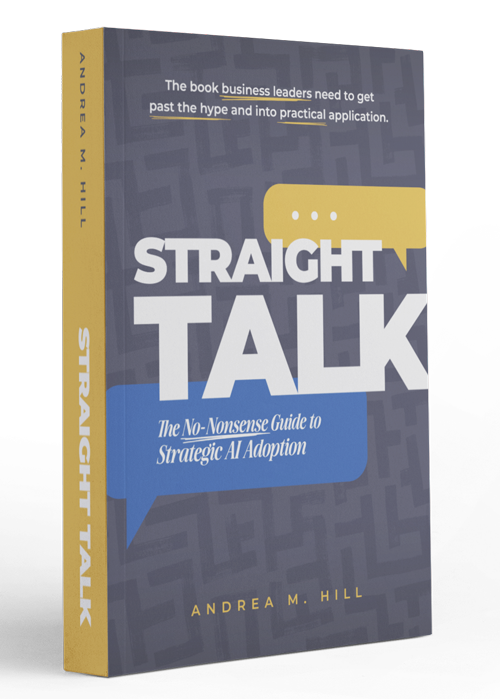
Where other books focus on prompts and tools, this book gives business leaders what they actually need: the frameworks and confidence to lead AI adoption responsibly, without having to become technologists themselves.