Customer-Centric Strategies for Sustainable Growth

When we talk about “sustainable” growth in this article, we don’t mean in terms of environmental responsibility, although that might also be part of your growth strategy. We’re talking about how to grow a business at a rate that you can keep up with, in a way that will keep reaping rewards in the long term.
While many big businesses are currently committed to growth at any cost, it’s not a strategy for long-term success, and it’s certainly not a strategy that small and medium-sized businesses can afford to pursue. I find myself thinking about this tweet a lot: “My 3-month-old son is now TWICE as big as when he was born. He's on track to weigh 7.5 trillion pounds by age 10.” Obviously, growth doesn’t continue endlessly on a consistent upward trajectory, whether we’re talking about organisms or businesses.
You can’t expect to double in size every three months forever, nor should you want to. Grow too fast and you’ll outpace your ability to serve your customers. Grow too slowly and you’ll stagnate and eventually lose customers to competitors. Sustainable growth strategies help you find the right balance. Centering your sustainable growth strategy on the customer keeps the focus on the mechanism of growth: increased sales and customer retention.
Develop Products That Customers Want
The focus on customers begins before you even have a product to sell. Too many businesses begin the product development process by asking questions like, “What kind of product would I want?” or “What am I capable of making?” They come up with an idea for a product or service, design the product, and then launch it.
What’s missing from this equation? The customer. These businesses never stop to ask if anyone even wants this particular product. Rather than beginning with an idea for a product, customer-centric businesses ask, “What do people need that we can provide?” After all, without customers, there are no sales, and without sales, there is no growth.
There are customers out there whose needs are not being met by the market. And then there’s your business, which brings together particular skillsets, outlooks, and values to either provide a unique product or a conventional product in a unique way. Where those two circles meet—what customers need and what you can provide—you’ll find your ideal customer.
Map the Customer Journey
That ideal customer is going to encounter your business in predictable ways. Once they find you, they’re going to have questions about your business, and they’re going to encounter things that make them consider your business as an option for them.
Our method for mapping the customer journey gives you an understanding of all of the ways a customer might interact with your business at every stage of the journey, from the moment they realize they have a need or a lack to the moment they make their purchase. You’ll end up with a clearer understanding of all of the customer’s pain points, all of the questions they consider when weighing their options, and what further education they need in order to make an informed decision.
What’s most important here is that you’re seeing your business from the customer’s perspective so that you can better align what you offer and how you offer it with what the customer wants.
Provide a Consistent Customer Experience
No matter how or where customers find you, they should find the same thing: a clear and consistent brand. Whether they enter a physical location, speak with a salesperson, browse your website, or find your social media, customers should encounter the same messages delivered in the same ways. If your sales reps, social media, and website are all saying different things, customers will likely be confused about who you are and if you’re the right business for them.
A customer-centric experience builds relationships with customers. When you build relationships, you encourage customer loyalty and repeat sales. Putting the customer at the center of the sales experience means considering what the customer wants and needs in every interaction. Yes, your ultimate goal is the sale, but putting pressure on the customer is not a tactic that often results in repeat business. Instead, empower the customer with the education they need to make an informed decision. Trust yourself and the quality of your products, and trust the customer to make the right choice.
Collect Feedback
Post-purchase surveys and product reviews are the most common kinds of customer feedback, but a customer-centric business collects feedback at every point of the customer journey. Salespeople should be asking how a potential customer found your business. Collect data on returns, whether through customer service representatives or online forms. Make it easy for customers to submit requests and suggestions for new products or features.
Bring It All Together With a CRM
Mapping the customer journey, collecting customer data, and soliciting feedback through various channels gives you an almost overwhelming wealth of information with which to develop a customer-centric growth strategy. A customer relationship management (CRM) system gives you a central hub from which to organize, analyze, and act on this information. We’re here to help you develop the growth strategy that works for your business and find the right CRM to keep everything running smoothly.
Andrea Hill's
Latest Book
Straight Talk
The No-Nonsense Guide to Strategic AI Adoption
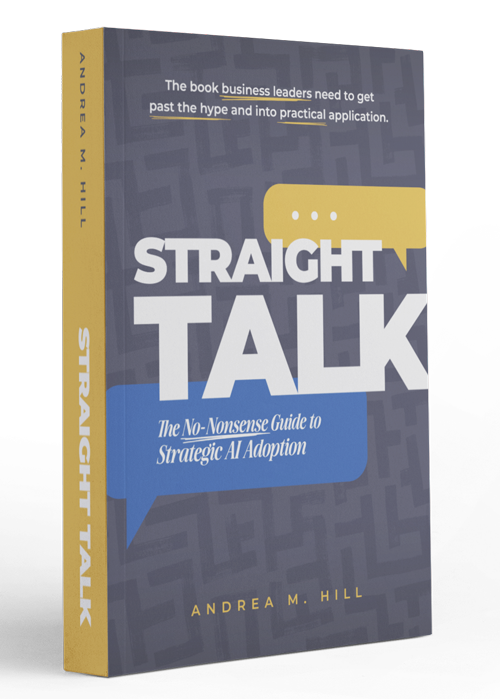
Where other books focus on prompts and tools, this book gives business leaders what they actually need: the frameworks and confidence to lead AI adoption responsibly, without having to become technologists themselves.